


A Michigan brain injury lawyer can help if you or a loved one suffered a serious head injury. You are likely traumatized, frightened, and perhaps unsure of how to proceed.
The resulting impact of a traumatic brain injury can lead to devastating emotional, physical, and personal losses.
Beyond this, a severe brain injury can prevent a person from returning to work, resulting in financial losses despite a growing pile of medical bills and fees for attendant care services. However, if your injuries were due to someone else’s careless, reckless, or malicious behavior, the ensuing costs should not be solely on you.
By filing a claim for compensation, you may be able to recover damages that help to ease your financial strain and allow you to focus on your recovery. Brain injury law requires your attorney be familiar with both the causes and effects of a closed head injury and brain damage in order to achieve the best possible result for you.
By enlisting a skilled and compassionate Michigan brain injury attorney at The Buckfire Law Firm, you will have help with each step of filing a brain injury claim for compensation.
Call a Michigan brain injury attorney today for your free case evaluation. We do not charge any legal fees unless you win a settlement!
- Signs of a severe head injury
- Misconceptions about traumatic brain injuries
- Most common causes of head injuries
- Compensation in brain injury lawsuits
- Brain injury settlement example
Signs and Effects of a Traumatic Brain Injury (TBI)
A traumatic brain injury (TBI) is defined as a blow to the head or a penetrating head injury that disrupts the function of the brain. A TBI can result when the head suddenly and violently hits an object, or when an object pierces the skull and enters brain tissue.
Not all injuries to the head result in traumatic brain injury, of course, and the severity of a brain trauma can range from “mild” to “severe.” A TBI can cause serious disabilities and have lasting or even permanent effects. It is important to recognize the signs, which may include:
- Persistent headaches or neck pain
- Coma
- Permanent brain damage
- Cognitive impairment
- Difficult remembering, paying attention, or making decisions
- Slowness in thinking, speaking, acting, or reading
- Getting lost or easily confusing
- Perception problems
- Feeling tired or lacking energy
- Sudden mood changes
- Blurred vision
- Ringing in the ears
- Decreased motor skills
- Changes in sleeping patterns
- Light-headedness, dizziness, or loss of balance
- Nausea
- Increased sensitivity to light, sound, or distraction
Our Michigan brain injury lawyers have worked with TBI victims for over 50 years. We understand the impact of a brain injury on both the victim and family, in cases ranging from car accidents, other motor vehicle accidents, to slip and fall injuries.
Contact us for a free consultation and we will explain how our law firm can help you pursue settlement compensation in your traumatic brain injury case.
Severe Head Trauma Can Lead to Aphasia
Along with these and other symptoms, severe head trauma can result in aphasia. Aphasia is a traumatic brain injury condition that results from damage to the areas of the brain responsible for language. Brain tissue can be damaged from a blow to the head.
For most people, this means the brain damage has occurred to the left hemisphere of the brain. This condition usually limits the ability of a patient to speak or communicate, although the degree to which a person’s language skills are affected will vary with each person.
Furthermore, concussions are the most common and least understood type of traumatic brain injury. A concussion occurs when the soft tissue of the brain is thrust against the hard bone of the skull. Concussions are particularly common among student athletes and youths who participate in recreational sports and activities.
The force of a blow or sudden movement affects the brain center controlling the blood vessels in the brain and creates a deficiency of blood supply to the brain. This can have a tremendous and long term impact on an individual’s life.
More immediately still, a brain injury may result in a coma. Because of the severity of these injuries, it is important for anyone who has suffered an injury to the head to seek medical attention immediately, as well as to contact an experienced Michigan brain injury lawyer for legal assistance.
Common Misconceptions About Severe Head Injuries
There are frequent debates between brain injury lawyers and even doctors in cases involving traumatic brain injuries and closed head injuries. Because many victims “look normal” to the average person, despite having significant cognitive deficits, there are common myths that must be overcome to prove the serious nature of the injury.
The most common misconceptions about traumatic brain injuries are:
- Myth 1: There must be a loss of consciousness after the accident. This myth has been disproved by physicians and scientists. A person does not need to be “knocked out” to suffer a brain injury and even a slight alteration of consciousness could be evidence of serious head trauma.
- Myth 2: The victim must forcibly strike their head on an object. This is untrue as sudden, unexpected movements of the head can cause the brain to strike the inside of the skull and suffer serious damage and harm, which is common in car accidents.
- Myth 3: There must be a negative result on imaging studies, like an MRI or CT Scan. It has been proven that a person can have a serious brain injury even with normal results
- Myth 4: Most people recover within 6 months of a brain injury. Although some people may have full or partial recovery within six months, many people have lifetime problems that never fully resolve even with extensive therapy and rehabilitation.
The Risk of a Seizure
Seizures that occur in relation to a head injury can be classified as Immediate (or Impact), Early (within several days to weeks of the injury), or Late (months to years after the injury, after recovery to the best-expected level of function). Head injuries can be broadly classified based on the extent of injury (mild, moderate, or severe) and on the type of injury suffered (missile or “penetrating” trauma, and closed or “blunt” trauma). Mild injury generally refers to the absence of injury to the brain or damage to the skull, and few neurological signs.
The classification of the type of brain injury can be a little confusing, because blunt trauma can produce ‘open’ head injuries with skull fractures and the entrance of skull fragments or foreign bodies into the cranial cavity. The exact mechanism of an injury is not always known, but is critical in understanding the extent and manner of an injury.
Acceleration-deceleration and rotational forces, associated with blunt trauma, penetrating trauma, and the effect of rapid movement of brain matter against the skull’s interior, can cause shearing injuries, to blood vessels and nerve fiber tracts.
As with all epileptic conditions, a proper diagnostic work-up is essential. The treatment of post-traumatic epilepsy is often complicated by the fact that there may be more than one area of focal brain trauma, and thus more than one area capable of generating epileptic discharges.
Certainly, the best treatment rationale begins with prevention. The proper use and application of helmets and seat belts significantly reduces the risk of head trauma, associated with sports-related, bicycle, motorcycle, and motor vehicle accidents.
The Glasgow Coma Scale
It’s important to assess the amount of damage that has been done when an individual suffers a traumatic brain injury — both for their personal health, as well as for a brain injury attorney to calculate the extent of their client’s losses for a claim. To do this, doctors and physicians use a scoring system known as the Glasgow Coma Scale, which measures the level of consciousness in a person based on a variety of different responses.
This tool has proven to be a reliable way for medical professionals to instantly gain an understanding of what type of brain injury they may be dealing with. This is also an effective tool for our attorneys to understand better the level of trauma that has occurred. The Glasgow Coma Scale measures three factors and scores them accordingly based on the level of response.
Medical professionals use the aggregate scores of this test to assess the level of damage to a person’s brain. By adding the 3 scores, the injury can be classified.
- Severe Brain Injury: GCS 3-8
- Moderate Brain Injury: GCS 9-12
- Mild Brain Injury: GCS 13-15
It is important to note that the Glasgow Coma Scale is used for adults who suffer from brain injuries. For children, a modified version of the GCS is used to test for traumatic brain injury.
The Common Causes of Traumatic Brain Injuries
A brain injury can occur from any number of circumstances. In Michigan, common causes of brain injuries include:
- Trips and falls
- Motor vehicle crashes—including cars, buses, trucks, and motorcycles
- Bicycle falls
- Pedestrian incidents—such as a person being struck by a vehicle
- Sports and recreational injuries
- Construction site incidents
- Police beatings
- Physical assaults
Often, these incidents are the result of someone’s careless or reckless action or inaction. Other times, it is due to directly malicious behavior. Even when the cause of a brain injury is an accident, like a car accident, the victim may have a legal right to pursue compensation from an at-fault person, business, or other entity.
Therefore, a Michigan brain injury lawyer will assess the facts of an incident that led to a brain injury in order to determine fault.
TBI-related Emergency Department Visit Statistics
According to the Center for Disease Control and Prevention, TBI-related ED visits increased 54% from 521.6 per 100,000 population in 2006 to 801.9 in 2014.
The line chart below shows the most common mechanisms of injury contributing to a traumatic brain injury diagnosis in the emergency department.
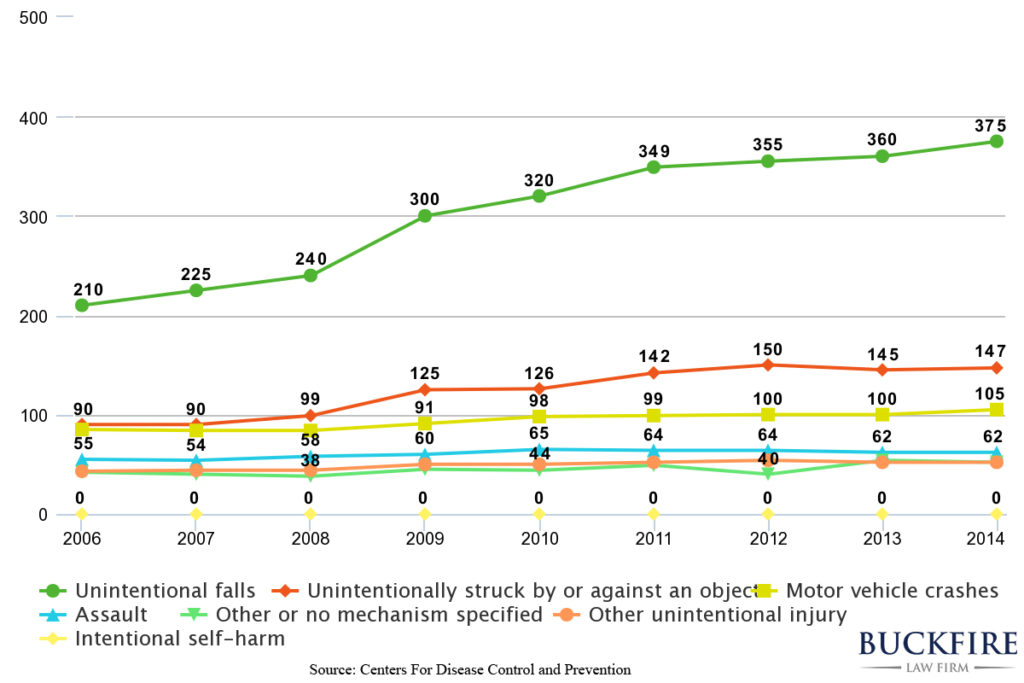
Unintentional falls, being unintentionally struck by or against an object, and motor vehicle crashes were the most common mechanisms of injury contributing to a brain injury (TBI) diagnosis in the emergency department. Traumatic brain injuries can result from any severe impact to the head.
The Center for Disease Control (CDC) reports there were approximately 2.5 million TBI-related ED visits in the U.S. in 2014, including over 812,000 among children. Many of these emergency department visits were the result of serious car accidents or other motor vehicle crashes. Prompt medical treatment can reduce the effects of long term brain damage.
Can I Sue for a Concussion Injury?
A concussion is a type of traumatic brain injury. It can be caused by bump, blow, or jolt to the head. A concussion can also be caused by a hit to the body that causes the head and brain to move rapidly back and forth. Concussions are also caused by impacts to a motor vehicle, especially rear-end collisions, that cause the head to thrust back and forth.
If you suffered a concussion from car accident, slip and fall, or other means, you can sue for your injury. The amount of your compensation depends on the severity of your concussion, the lengthy of your treatment, and how the affects of the concussion have damaged your brain and cognitive processes. An experienced personal injury lawyer get you the most compensation.
Our Michigan brain injury lawyers have great success in winning large settlements for concussion victims. Contact us now to see how we can win you a great settlement.
Getting Compensation for a Michigan Traumatic Brain Injury
A traumatic brain injury victim can claim for compensation for a number of economic and non-economic damages. These might include medical expenses, pain and suffering, loss of enjoyment of life, lost wages, decreased earning capacity, and loss of consortium.
However, before these and other damages can be collected, an injured plaintiff must first be able to prove that an at-fault party was negligent. The legal process of doing this is often complex and involves establishing a defendant’s legal duty and breach of this duty, as well as how this breach resulted in the claimant’s injuries.
For example, if a motorist was texting while behind the wheel, this would be a breach of their duty to drive reasonably and safely. Therefore, if this breach—their distraction—caused them to hit a person while they were walking or driving, that person would have strong legal grounds for a claim.
By enlisting well-versed Michigan brain injury lawyer, an injured individual can hold an at-fault individual responsible for covering their damages in Michigan. Our Michigan personal injury law firm has helped people who have suffered a brain injury, and their families, pursue compensation since 1969. Our award winning personal injury lawyers have achieved great results in brain injury cases and will do the same for you.
Michigan Brain Injury Case Study
An emergency room physician was seriously injured in a rear-end car accident. His vehicle was struck at high speed while waiting to turn left at a stop light.
The negligent driver was cited for failing to stop within the assured clear distance ahead.
The injured plaintiff suffered a traumatic brain injury and other injuries. His brain injury prevented him from returning to work and he suffered a substantial loss of income. His lifestyle was also changed and his relationships were affected by his injuries. He also required extensive medical care and rehabilitation.
The case was settled for $1.93 million for claims related to his pain and suffering and excess economic loss. His medical bills and other expenses were also paid.
No-Fault Insurance in Michigan
If the victim of a brain injury was a motorist, cyclist, or pedestrian, there is a chance they could instead seek compensation through Michigan’s no-fault insurance system. Unlike a civil lawsuit, a claimant does not have to prove that another motorist or individual was responsible for their damages in order to recover damages.
Insurance companies are famous for denying claims of TBI victims. The insurer will often hire its own doctor to perform an independent medical examination or IME. These doctors are paid great sums of money by insurance companies to give opinions to support a denial of payment for medical treatment.
Our personal injury law firm has battled insurance companies and their doctors on a regular basis since 1969. We know their tricks and how to defeat them.
Contact our experienced Michigan brain injury attorneys today if your claims have been wrongfully denied. We will start working on your injury case immediately.
Brain Injury Awareness Month
A brain injury can happen anytime, anywhere, to anyone. In fact, these severe injuries are more common today than ever before, contributing to 30 percent of all deaths. Due to this reason, you and your loved ones should learn more about awareness and advocacy in the community. Traumatic brain injures affect the entire family.
March is marked as Brain Injury Awareness Month. The public can get involved with several initiatives and advocacy events to help promote brain injury awareness during this month.
Call a Michigan Brain Injury Lawyer for Help
Suffering a traumatic brain injury may force a person out of work despite the need for extensive medical treatment and assisted living care. This might make a person feel as though their situation is hopeless. However, you have legal options if you or a loved one was involved in an incident.
Navigating the claims process and legal system to seek compensation can be confusing and difficult for under-prepared claimants. Brain injury law is very complex and it is essential to have and experienced Michigan brain injury attorneys on your side.
A tenacious and seasoned Michigan brain injury lawyer at The Buckfire Law Firm will explain your rights, investigate your circumstances, and work to build a claim that suits your needs.
Call one of our award-winning Michigan brain injury lawyers to get started on your free case evaluation. We charge no legal fees unless you win a settlement!
Michigan Brain Injury Lawyer Resources






(Main)
- 29000 Inkster Road
Suite 150
Southfield, MI 48034
- Phone: (248) 595-7544
- 19 Clifford St.
Suite 805 Merchants Row
Detroit, MI 48226
- Phone: (313) 992-8281
(Woodward Address)
- 1001 Woodward Ave.
Suite 505
Detroit, MI 48226
- Phone: (313) 777-8482
- 343 S. Main Street
#206
Ann Arbor, MI 48104
- Phone: (734) 888-3003
- 51424 Van Dyke Ave
#3
Shelby Township, MI 48316
- Phone: (586) 250-2626
- 432 N. Saginaw Street
Suite 413
Flint, MI 48502
- Phone: (810) 818-8182